Bulgaria’s Election Spiral: Scratching Beneath the Surface

Where is Bulgaria headed after the fifth parliamentary election in the span of two years? My latest piece for New Eastern Europe titled “Bulgaria’s election spiral: the anatomy of disappointment” explains why the current political crisis can only be overcome if its roots are properly understood and addressed. In a country like Bulgaria, where appearances may often be deceiving, however, identifying these causes is not a straightforward task.

  • What does Boyko Borissov have to lose if his party is not part of government?
  • What strategies has Bulgaria’s status quo employed to sabotage the formation of a stable regular government in the past two years?
  • Who are the “poisonous lookalikes” on the Bulgarian political stage and what are they used for?
  • Why did President Rumen Radev drastically alter his views on the rule of law and Borissov?
  • How can we explain the rise of the pro-Russian “Revival” and to what extent is the threat to Euro-Atlanticism in Bulgaria real?
  • What do the latest voting patterns tell us?

You can read my full article here.

Will Bulgaria Finally Separate the Wheat from the Chaff on Its Political Stage?

Earlier this month, I analyzed the deepening political crisis in Bulgaria in the context of the forthcoming parliamentary election in April 2023 for Res Publica, an academic blog edited by the Institute of Communication Studies of North Macedonia. In my commentary, I explain in details how an autocracy resists its dismantling and why an election spiral is not necessarily a bad thing given the circumstances. I republish my article “Bulgaria’s Deepening Political Crisis: An Opportunity to Separate the Wheat from the Chaff” with the permission of the editors:

Read More

Elections and Drama

In my latest article for New Eastern Europe published shortly after the parliamentary elections which took place on April 4th, 2021, I discuss the importance of these specific elections, the likely scenarios, and the reluctance with which Boyko Borissov will eventually transfer power.

Even before the Parliament was convened, I argued: “In parallel, the opposition is fragmented, so while preferable, they may not be able to form a government either. This means that the most likely scenario is a caretaker government and new parliamentary elections this year.” I also contended: “The future may be uncertain at this stage, but the election results are actually a massive victory for Bulgaria’s civil society.”

You can read the full text of my article ‘Dramatic parliamentary elections in Bulgaria: will Borissov transfer power peacefully?’ here.

Parliamentary Elections in Bulgaria

On 4 April 2021 or in 4 days, Bulgarian citizens will vote for a new Parliament. Unusual elections, considering Bulgarians have been protesting against Boyko Borissov’s government for 8 months and Borissov did everything possible to avoid early elections, which means these are the first parliamentary elections organized by a government led by Boyko Borissov. I have written an article for Res Publica about the incredibly high stakes which was published earlier today. I republish it here with the permission of the editors.

Read More

An Autocratic Christmas, An Autocratic Winter

Despite more than 160 days of protests, Boyko Borissov’s government stubbornly refuses to resign. Moreover, it has engaged in yet another assault against the rule of law. In my latest piece for the Verfassungsblog, I showcase how Borissov’s government is trying to mislead the European Commission that it has taken its concerns in Bulgaria’s report under the new Rule of Law Mechanism seriously. In essence, Bulgaria’s government has put forward an action plan consisting of various steps – many of them are irrelevant to the Commission’s concerns, even a greater number are anti-constitutional. You can read my piece titled “Borissov’s Latest Plan to Avoid True Reforms: On Bad Habits, the CVM, and the New Rule of Law Mechanism” here.

Read More

A Grand National Assembly or Grand Bulgarian Chicanery?

Earlier this month I was invited to comment on Boyko Borissov’s latest ideas for constitutional reform by the Verfassungsblog. Those following the decline of Bulgaria’s rule of law and those who have respect for constitutionalism will not be surprised by my conclusions. Borissov is abusing the Bulgarian legal concept of a grand national assembly to prevent fairer elections. GERB’s proposal for a new constitution lacks merit. It is largely based on the current Constitution. The few amendments it introduces are of questionable value: they are ill-drafted or designed to deliver a blow to parliamentarism. You can read my full contribution entitled “A Grand National Assembly or Grand National Chicanery?” here.

Will Borissov’s Government Survive This Summer?

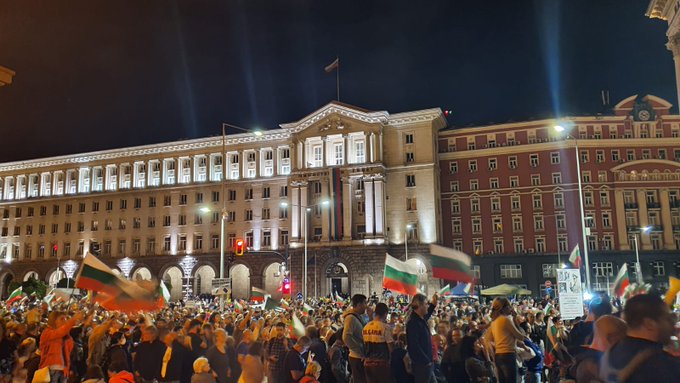
As you probably know, mass protests erupted in Bulgaria on 9 July 2020 after Bulgaria’s Prosecutor’s Office raided Bulgaria’s Presidency in an attempt to orchestrate a coup. Bulgarians demand the immediate resignation of Boyko Boriossov’s government and controversial General Prosecutor Ivan Geshev who engages in politically motivated prosecutions in violation of the Constitution, the ECHR, and the EU Charter. President Rumen Radev is the only critic of Prime Minister Boyko Borissov who has a high position in the state and Bulgaria’s Presidency is essentially the only institution which has not been fully captured. In June 2020, way before the protests started, I wrote this article for New Eastern Europe: “Bulgaria: will Borissov’s government survive this summer?”. It does not cover the protests, but I think it will further showcase to you why citizens are on the streets. Nearly 100,000 people protested in Sofia on 15 July 2020. We are about to see if my title is prophetic.