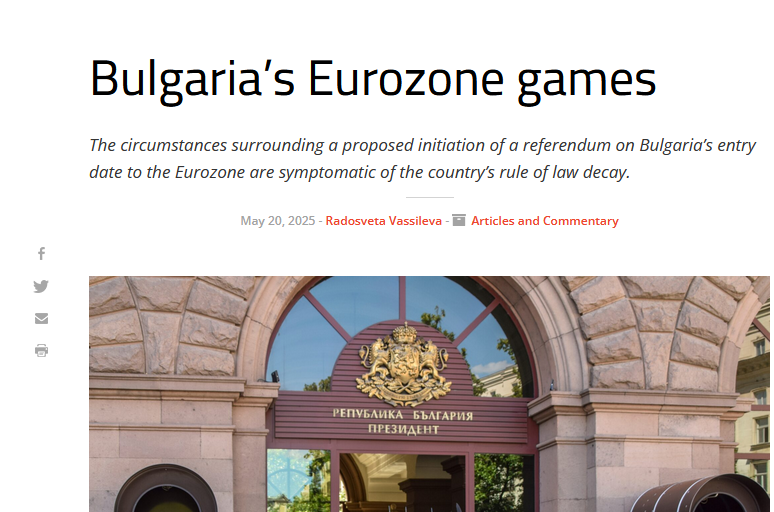
Eurozone, Here We Come! But What’s the Price Tag?
Earlier this year, I wrote an article titled ‘Bulgaria’s Eurozone games’ for New Eastern Europe in which I argued that the rush to join the Eurozone and the manipulation of data and statistics accompanying it was symptomatic of the country’s rule of law decay. Rosen Zhelyazkov’s government, permanently torn by corruption scandals, demanded an extraordinary convergence report by the EU Commission and the ECB in spring 2025, possibly in an attempt to polish its rather tarnished reputation. Meanwhile, via the law on the budget adopted in a haste at the same time, Bulgaria concealed a new debt of more than 7 billion leva (3.5 billion EUR) as an increase in the capital of Bulgarian state-owned companies. In parallel, the Minister of Finance Temenuzka Petkova announced that all profit by state-owned companies would be “collected” in favor of the state. This leads to educated guesses that Bulgaria’s true deficit is above 6 per cent, while pursuant to the Maastricht (convergence) criteria, the budget deficit should be less than 3 per cent for a country to be eligible for the Eurozone.
I also explained that EU institutions have a long history of turning a blind eye to irregularities, falsifications, and overall rule of law decay in Bulgaria, so it was highly likely that politics and geopolitics would trump sober judgment. The only question I left open was whether the ECB would look the other way. Sadly, in June, when Bulgaria’s convergence report was released, it was clear that the ECB was happy to play along with the EU Commission and turn a blind eye to tweaked data too.
Read More
 Personal Blog of Dr. Radosveta Vassileva