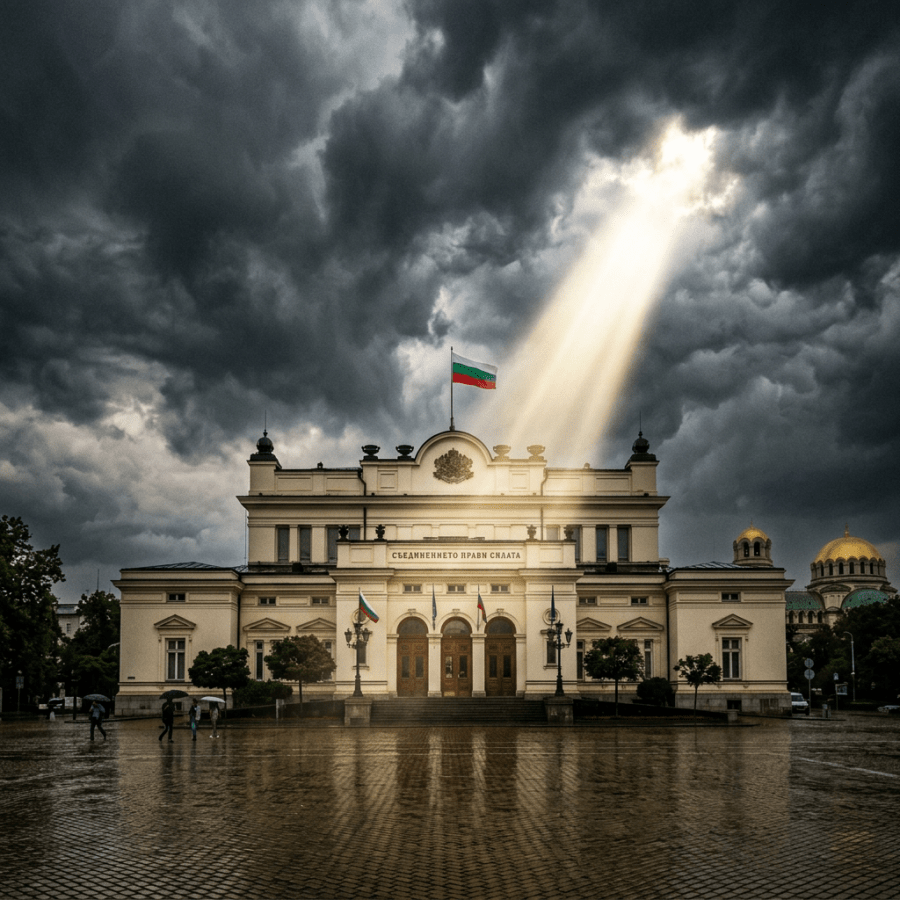
Bulgarian National Assembly building illuminated by a sunbeam under dark storm clouds

Bulgaria at the Rule of Law Crossroads: Where Next After the April 2026 Election?

On 19 April 2026, Bulgaria will face its eight parliamentary election in the span of five years. The main difference this time is that there is a new player in the political field – earlier this year President Rumen Radev resigned from office to establish his own political project with the ambition to fight the corrupt establishment of Boyko Borissov and Delyan Peevski. Polls show that his ‘Progerssive Bulgaria’ will win this election.

How did we get here? What are the stakes for the rule of law? Will there be a regular government after this election? More importantly, will Radev be able to deliver on his promises?
In March, just before the start of the election campaign, I shared my thoughts with New Eastern Europe. You can read my full commentary titled ‘Bulgaria at the rule of law crossroads: can Rumen Radev become the much-needed game changer?’ here.

Quo vadis Bulgaria?

In my latest piece for New Eastern Europe titled “After yet another election, where are you heading Bulgaria?”, I discuss why Bulgaria has entered a seemingly never-ending cycle of parliamentary elections.

Regrettably, Bulgaria’s status quo forces rely on a panoply of Trojan horses to sabotage anti-corruption reforms and save actors implicated in corruption from accountability. The latest disappointment is President Rumen Radev who seems to be collaborating with the parties accused of corruption – namely, GERB and DPS – behind the scenes. I conclude that “[if] a regular government is formed this time, its goal will not be to protect the future of Bulgaria, but to ensure the impunity of Borissov and the key players in his autocracy”.

Will Borissov’s Government Survive This Summer?

As you probably know, mass protests erupted in Bulgaria on 9 July 2020 after Bulgaria’s Prosecutor’s Office raided Bulgaria’s Presidency in an attempt to orchestrate a coup. Bulgarians demand the immediate resignation of Boyko Boriossov’s government and controversial General Prosecutor Ivan Geshev who engages in politically motivated prosecutions in violation of the Constitution, the ECHR, and the EU Charter. President Rumen Radev is the only critic of Prime Minister Boyko Borissov who has a high position in the state and Bulgaria’s Presidency is essentially the only institution which has not been fully captured. In June 2020, way before the protests started, I wrote this article for New Eastern Europe: “Bulgaria: will Borissov’s government survive this summer?”. It does not cover the protests, but I think it will further showcase to you why citizens are on the streets. Nearly 100,000 people protested in Sofia on 15 July 2020. We are about to see if my title is prophetic.