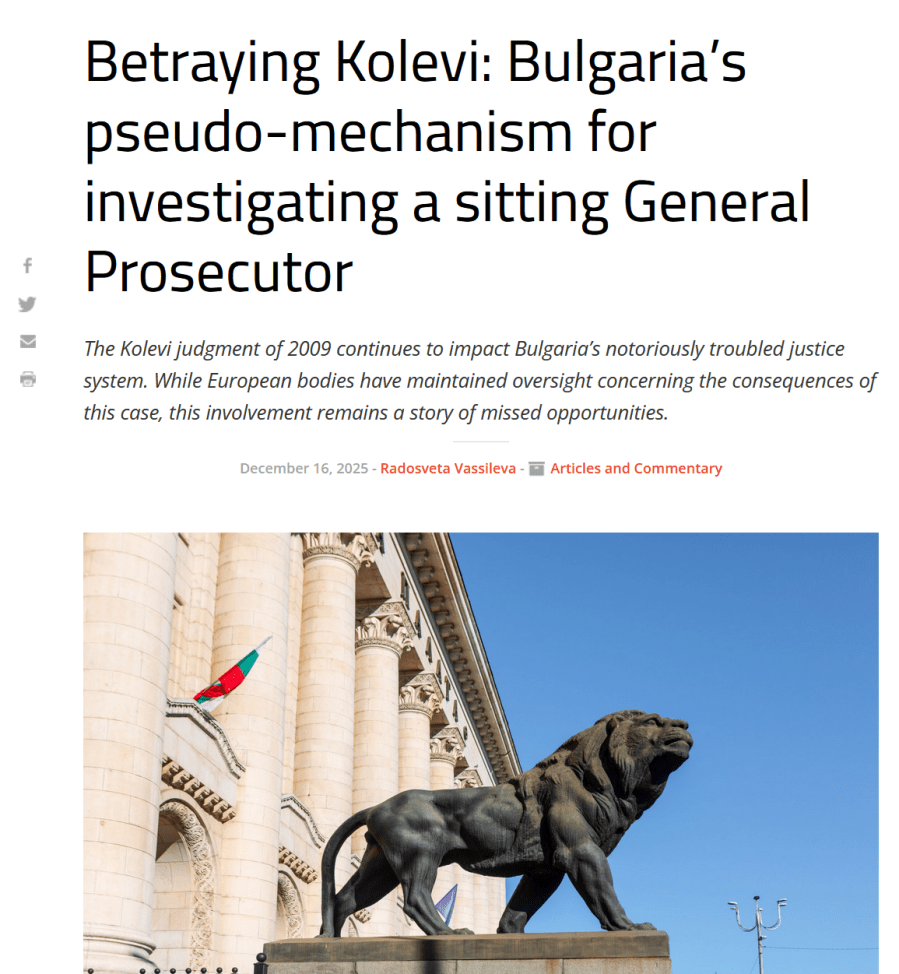
16 Years of Failure to Implement Kolevi – the Most Pivotal ECtHR Judgment Concerning Bulgaria’s Rule of Law

My latest article for New Eastern Europe concerns Bulgaria’s rampant failure to implement the Kolevi ECtHR judgment of 2009. This is the most pivotal judgment concerning Bulgaria’s rule of law because it identifies a core structural problem of the justice system – the centralized structure of the Prosecutor’s Office and the resulting impunity of a sitting General Prosecutor.

Sadly, the EU Commission has only exacerbated the problem with its inertia in Bulgaria’s reports under the Cooperation and Verification Mechanism (CVM) as well as the reports under the new Rule of Law mechanism. This, of course, raises suspicions of complicity.

You can read the full text of my article titled ‘Betraying Kolevi: Bulgaria’s pseudo-mechanism for investigating a sitting General Prosecutor’ here.

Already in 2020, I rang the alarm about Bulgaria’s refusal to implement the judgment in ‘Kolevi: Bulgaria’s 10-Year Cat-and-Mouse Game with the Council of Europe and the Venice Commission’ published by the Verfassungsblog.

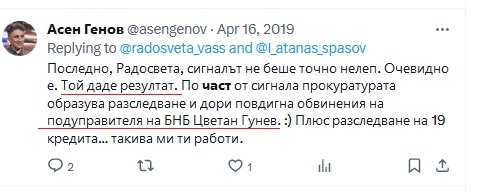
Прословутият сигнал на “Протестна мрежа”. Или как един злонамерен балон се спука

По-рано тази година, на обща пресконференция на гражданското сдружение “БОЕЦ” и медията “Бърд”, беше представена част от личния архив на Пепи Еврото, който е попаднал при тях случайно. Докато “БОЕЦ” и “Бърд” са целели изобличаване на Пепи Еврото, те постигнаха и друго – изобличаване на “Протестна мрежа” – тъй като от частичния архив изплуваха два сигнала, приписани на “Протестна мрежа”, срещу Цветан Василев и КТБ. Първият е прословутият сигнал срещу “Пеевски-Василев-Бареков”, който е използван от прокуратурата само в частта си срещу Цветан Василев и който е основен предмет на тази статия.

Използвам думата “приписани” неслучайно, тъй като лично имам съмнения кой е истинският автор на тези два сигнала. Първият е формално разписан от членове и сподвижници на “Протестна мрежа”, докато вторият е разписан единствено от Николай Стайков, понастощем ребрандиран като “журналист” в Антикорупционния фонд.

Защо изтичането на първия сигнал, както и на резолюциите на прокуратурата по него, поставя разписалите го в неловка ситуация? Защото въпреки че едно десетилетие първият сигнал беше представян като заковаващ и добре мотивиран, той всъщност е един мишмаш от медийни публикации от кръга “Капитал”, както и такива, зад които прозира “Капитал”, и който е гарниран с емоции, вкл. неомарксистки призиви и въжделения. В правова държава, прокуратура не би обърнала никакво внимание на такива общи приказки, особено пък в частта “КТБ”. Но тъй като България не е такава, същият сигнал е не само използван, но и допълнен от Пепи Еврото и компания!

Оттук произтичат серия нелицеприятни въпроси, съмнения и предположения, тъй като точно този сигнал заедно с анонимен сигнал на Пепи Еврото е използван за рейда на КТБ през юни 2014 г.

Read More
Bulgaria’s Constitutional Drama and the Recent Judgment by the Constitutional Court

On 26 July 2024, Bulgaria’s Constitutional Court declared a significant part of constitutional amendments enacted in a rush in December 2023 unconstitutional. These amendments were allegedly aimed at the depoliticization of the Supreme Judicial Council and the decentralization of the Prosecutor’s Office, and had been praised as progress in the country’s latest 2024 Rule of Law report by the EU Commission. Yet, a closer looks shows that the amendments do not comply with key recommendations by the Venice Commission and could worsen an already dire situation.

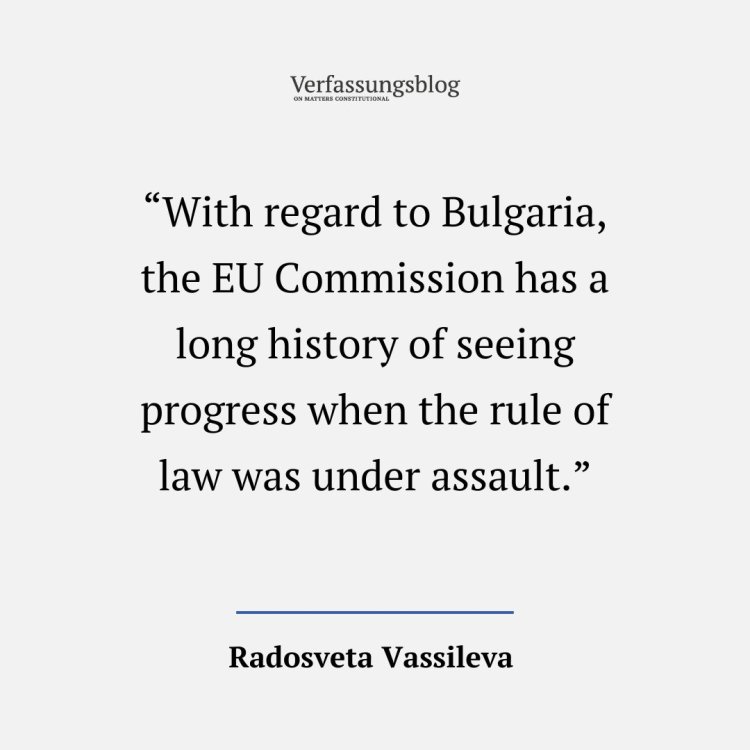
Sadly, in the case of Bulgaria, the EU Commission has a long history of seeing progress when the rule of law is under assault, as visible by the failed Cooperation and Verification system which did not help the country solve a single major rule of law challenge. Why does the EU Commission recognize as progress any step in any direction without analysis of its merit in context? You can read my latest analysis of the Verfassungsblog here.

Under the Bright Lights: Bulgaria’s Mafia State and the Failure of the CVM

The dismissal of a General Prosecutor, prosecutorial wars, a war between a General Prosecutor (Ivan Geshev) and a former Prime Minister (Boyko Borissov), brutal murders…

This is not a thriller – this is Bulgaria! Moreover, this is Bulgaria under the guidance of the Cooperation and Verification Mechanism (CVM), which was supposed to help it catch up with other Member States in the area of the rule of law.

Happy to share my latest post for the Verfassungsblog in which I discuss the latest troubling developments and the European Commission’s flagrant omissions in the CVM. You can read “Bulgaria’s Mafia State and the Failure of the CVM” here.

Bulgaria’s Persistent Interpol Abuses

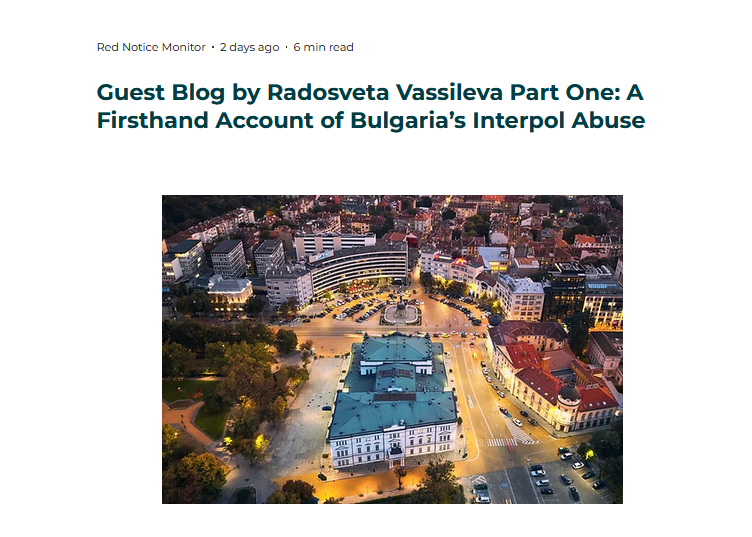
Are you aware that Bulgaria abuses Interpol’s system just like rogue states like Russia and Turkey?

In a two-part guest blog for the Red Notice Monitor, a blog specialized in reporting on Interpol abuse, I explain in detail four cases in which the Commission for the Control of Interpol’s Files (the CCF) has established prosecution in violation of the Universal Declaration of Human Rights by Bulgaria. The Red Notice Monitor is edited by leading experts in human rights, extradition, and Interpol abuse in the UK.

Read More

Няколко думи за последните пиеси на Иван Гешев

За съжаление от години българските медии отразяват безкритично твърдения на български прокурори, независимо дали те звучат абсурдно и/или показват фундаментално погазване на закона. Примерите изобилстват!

В този план, във връзка с последните нелепици, изречени от главния прокурор, който замеси името на баща ми в поредната си пиеса, предлагам на вашето внимание публичното изявление на Цветан Василев от 10.04.2023 г. Изказвам и възмущението си, че медиите повториха и разпространиха нелепи лъжи по адрес на баща ми. За сметка на това, поради “високата” си етичност, нито го потърсиха за коментар, нито отразиха изявлението му по повод медийните фойерверки на Иван Гешев.

Няколко акцента от изявлението:

Read More

Will Bulgaria Finally Separate the Wheat from the Chaff on Its Political Stage?

Earlier this month, I analyzed the deepening political crisis in Bulgaria in the context of the forthcoming parliamentary election in April 2023 for Res Publica, an academic blog edited by the Institute of Communication Studies of North Macedonia. In my commentary, I explain in details how an autocracy resists its dismantling and why an election spiral is not necessarily a bad thing given the circumstances. I republish my article “Bulgaria’s Deepening Political Crisis: An Opportunity to Separate the Wheat from the Chaff” with the permission of the editors:

Read More

Quo vadis Bulgaria?

In my latest piece for New Eastern Europe titled “After yet another election, where are you heading Bulgaria?”, I discuss why Bulgaria has entered a seemingly never-ending cycle of parliamentary elections.

Regrettably, Bulgaria’s status quo forces rely on a panoply of Trojan horses to sabotage anti-corruption reforms and save actors implicated in corruption from accountability. The latest disappointment is President Rumen Radev who seems to be collaborating with the parties accused of corruption – namely, GERB and DPS – behind the scenes. I conclude that “[if] a regular government is formed this time, its goal will not be to protect the future of Bulgaria, but to ensure the impunity of Borissov and the key players in his autocracy”.

Extradition to Russia from an EU Member State

Earlier this month, I shared my thoughts on the first-instance decision in Alexey Alchin’s extradition proceedings for the Verfassungsblog. I argued that behind this decision lurk 1) judicial incompetence as the first-instance court could not even get the applicable law right; 2) the subservience of Bulgarian judges to the omnipotent Prosecutor’s Office which has unhealthy ties with Russia’s Prosecutor’s Office; 3) overall rule of law decay.

Luckily, the second-instance court quashed the first-instance decision today. However, I am convinced that this is the case because of public pressure – a number of influential figures took an interest in the proceedings against Alchin. Had the first-instance decision gone unnoticed by civil society, the second-instance decision could have been very different.

You can read my original commentary for the Verfassungsblog titled “Extradition to Russia from an EU Member State: Judicial Incompetence, Political Bias, or Just Another Sign of Rule of Law Decay?” here.

The End of an Experiment: Borissov’s Specialized Criminal Courts

On 14 April 2022, Bulgaria’s Parliament adopted amendments to the Law on Judiciary and related legislation to permanently dissolve a parallel court system built during Boyko Borissov’s first term as Prime Minister – the Specialized Criminal Court, acting as a first and second instance, and the Specialized Prosecutor’s Office supposed to fight corruption and organized crime. Even before these institutions started working, one could see that they would be politicized and used for harassment of inconvenient people. This is primarily due to the fact that they are a misplaced legal transplant – they were transplanted in a justice system with severe structural problems which remained unattended, without consideration for the specifics of the local legal culture and without evidence that they would be successful at fighting corruption. Unsurprisingly, this parallel court system established a strong record of ignoring basic principles of criminal law and violating human rights, too. Unfortunately, these troublesome developments were encouraged by the European Commission via the Cooperation and Verification Mechanism (CVM) under which Bulgaria’s rule of law has been monitored since the country’s accession to the EU.

Last month, I was invited to write a commentary on the rise and fall of specialized criminal justice in Bulgaria for the Verfassungsblog – you can read my article “Bulgaria’s Failed Specialized Criminal Justice Experiment” in full here. Also, since the failure of the CVM is a long-standing research interest of mine, I am sharing my academic article ‘Threats to the Rule of Law: The Pitfalls of the Cooperation and Verification Mechanism” published in European Public Law (Kluwer), in case you want to learn more about the European Commission’s mistakes and omissions in the process.

The Struggle for the Rule of Law in Bulgaria: My Interview for the Global Liberty Alliance

In February this year, Mr. Jason Poblete, President of the Global Liberty Alliance, a non-governmental organization in the USA which defends human rights, invited me for an interview. He was interested to learn more about the rule of law decay and human rights abuses in Bulgaria, including how and why I started my journey in defending human rights.

We scheduled the interview for March, but as it turns out, the timing was perfect because on the day of the interview, the Chairman and Vice-Chairman of the US Senate’s Foreign Relations Committee issued an unprecedented joint statement emphasizing that “…persistent corruption, declining media freedom, politicization of the judiciary, and other threats to the rule of law pose[d] serious challenges to the U.S.-Bulgaria bilateral relationship.”

Read More

An Autocratic Christmas, An Autocratic Winter

Despite more than 160 days of protests, Boyko Borissov’s government stubbornly refuses to resign. Moreover, it has engaged in yet another assault against the rule of law. In my latest piece for the Verfassungsblog, I showcase how Borissov’s government is trying to mislead the European Commission that it has taken its concerns in Bulgaria’s report under the new Rule of Law Mechanism seriously. In essence, Bulgaria’s government has put forward an action plan consisting of various steps – many of them are irrelevant to the Commission’s concerns, even a greater number are anti-constitutional. You can read my piece titled “Borissov’s Latest Plan to Avoid True Reforms: On Bad Habits, the CVM, and the New Rule of Law Mechanism” here.

Read More

An Interview for the Green European Journal

In late October, I was contacted by the Green European Journal, the independent publication of the Green European Foundation, which is one of the political foundations at an EU level. They wanted to learn more about Bulgaria’s longstanding challenges in the area of the rule of law. We talked for an hour about diverse issues – from corruption and rule of law decay, through rigged elections and scandals, to the future alternatives for Bulgaria, including the role of the Greens. I was surprised that they published our conversation almost in its entirety. You can read my interview here.

The Commission’s Rule of Law Reports: A Diagnosis or an Autopsy?

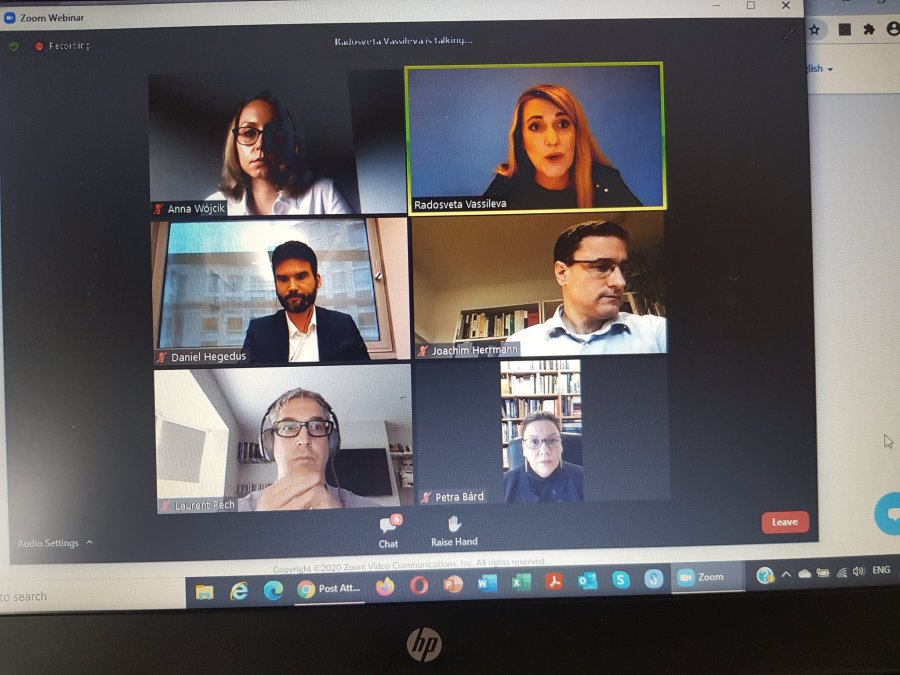
On 5 October 2020, the German Marshall Fund of the United States held a webinar dedicated to the first rule of law reports released by the European Commission under the new, much anticipated Rule of Law Mechanism. While the event was announced much before the publication of the reports, its title gave away the fears of rule of law experts – “Assessing the State of Rule of Law in the European Union: Diagnosis or Autopsy?”

I was honored to be invited to serve as one of the panelists along with Prof. Laurent Pech, Prof. Petra Bard, Anna Wójcik, who is the co-founder of Rule of Law in Poland, and Joachim Herrmann from the Cabinet of Commissioner Dreynders. As one could expect, the rule of law experts on the panel entertain very different views on the usefulness and the objectivity of these rule of law reports compared to the formal position of the European Commission. All of us seem to concur that the Commission spares hard truths for governments and that the reports rely heavily on euphemisms. I do believe that the criticism the Commission received was constructive and may benefit its own assessments in the future.

If you are interested in the debate, you can watch the recording on YouTube here. Prof. Pech discussed the general deficiencies of this mechanism while the rest of us critically evaluated the country chapters on Poland, Hungary, and Bulgaria:

Read More

When Standards are Dual

Bulgaria’s fiery summer of protests led to a stormy fall. Sadly, there is a bitter feeling of dual standards in the air.

The government is clearly uncomfortable with the protests, so it resorted to a shameful trick typical of autocratic regimes – violence. Sadly, the EU Commission chose to look the other way. You can read my article “Protests in Bulgaria: will the EU at least condemn the violence?” for The Brussels Times here.

In stark contrast to the nonchalance of the EU Commission, the EU Parliament took some interest in Bulgaria’s democratic backsliding. At a hearing of the LIBE Committee dedicated to the rule of law decay in Bulgaria, however, Commissioner Vera Jourova, whose portfolio includes values and transparency in the EU, was afraid to depart from her institutional point of view and maintained that Bulgaria had been making steady progress under the Cooperation and Verification Mechanism which monitors the country in the areas of rule of law, corruption, and organized crime. You can read my article “On Coins, Parallel Universes and the Cooperation and Verification Mechanism” for the Verfassungsblog in which I showcase the pitfalls of this mechanism and the hypocrisy of the EU Commission.

Read More

An Explosive Summer

The mass protests in Bulgaria of 2020 will be remembered for many reasons – the persistence of citizens, the fact that right-wingers and left-wingers stand together against corruption and autocracy, the police violence, the arrogance and political games of Borissov’s government and his GERB party and, sadly, the silence of EU institutions.

In August, I published my article entitled “Protests in Bulgaria: EU values, wherefore art thou?” with New Eastern Europe. I showcase the ambiguous reaction by EU institutions towards the protests and the dual standards regarding the rule of law which become more and more visible.

I was also interviewed for the Talk Eastern Europe podcast in early August about the protests and the perspectives ahead. As the hosts noted, Bulgaria is rarely covered by international media, so few people abroad are aware of the gravity of the political disaster which struck. You can listen to my interview here.

If you follow me, you know I often write about Bulgaria’s rule of law decay.

You can find a list of my blog posts and some of my articles for the media here! You can follow me on Twitter @radosveta_vass!

Bulgaria’s Ignored Rule of Law Crisis

Earlier this month, I wrote an article for the blog of the #FBPE movement (Follow Back, Pro-European) about the challenges which Bulgaria faces in the area of rule of law and why the mass protests started. The hashtag was first used by Mr. Hendrik Klaassens in response to Brexit, but it quickly transformed into a movement. Currently, FBPE is even a word defined in English dictionaries. I am very grateful that they are now turning their eyes to and following the rule of law crises in Eastern Europe. You can read my contribution “Bulgaria’s Ignored Rule of Law Crisis” here.

If you follow me, you know I often write about Bulgaria’s rule of law decay.

You can find a list of my blog posts and some of my articles for the media here!

Bulgaria, a Rule of Law Crisis in All but Name

In January 2020, Transparency International reconfirmed Bulgaria as the most corrupt EU member in its authoritative Corruption Perceptions Index. This is a good, but sad occasion to inform you about my latest media articles:

  • In December 2019, I warned that Bulgaria was sabotaging the work of the future European Public Prosecutor in an article for Euronews. As you can imagine, the government was quite unhappy and responded with a libelous article published in their favorite tabloid (24 Chasa). If you cannot attack the argument, attack the author.
  • In February 2020, I raised concern about the water crisis in Pernik, which I deem to be an illustration of what the lack of rule of law leads to, in an article for New Eastern Europe. The health and safety of more than 100,000 European Union citizens is at peril as a result of incompetence and negligence, but international media and EU policy-makers ignore this disaster.
  • In February 2020, I showcased Bulgaria’s 10-year cat-and-mouse game with the Council of Europe in an article for the Verfassungsblog. Bulgaria has been refusing to comply with a decision by the European Court of Human Rights for a decade because it requires a reform of an institution which experts consider one of the biggest threats to the rule of law – Bulgaria’s Prosecutor’s Office.

All of these events provide further evidence that Bulgaria is a rule of law crisis in all but name – an argument I have made for the EUobserver in 2018. Sadly, this is possible because of the complicity of EU institutions.

For the latest updates on Bulgaria’s rule of law, follow me on Twitter @radosveta_vass!

Could Football Be a Litmus Test for the Rule of Law? My Latest Article for Euronews

Were you shocked by the racist abuse at the Bulgaria-England Euro qualifier? I never thought I would combine my interest in football with my concern for Bulgaria’s rule of law, but I felt compelled to take a stand. I have a huge admiration for people in professional sports because sports illustrate many of the qualities we aspire to – commitment, discipline, and hard work. Most of all, sports inspire us, ordinary people. The name of the game for true fans will always be football, but in Bulgaria, corruption is the bigger game. My commentary for Euronews entitled “Racism at the heart of Bulgarian football is becoming a litmus test for the rule of law” can be found here.

Vlog Post: The Failure of Bulgaria’s Cooperation and Verification Mechanism (CVM)

In this video post, I explain how and why the Cooperation and Verification Mechanism (CVM) failed in Bulgaria. When Bulgaria and Romania joined the European Union (EU) in 2007, they did not entirely fulfill the criteria on the rule of law. That is why, they were placed under this mechanism, so that they could catch up with other Member States. Twelve years later, little progress (if any) has been achieved.

Read More