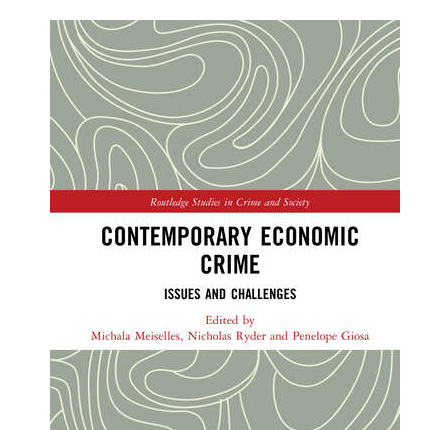
‘Is it Possible to Fight Corruption in a Post-Communist Captured State?’ is the question I purport to answer in a chapter which is forthcoming in Michala Meiselles, Penelope Giosa and Nicholas Ryde (eds), Contemporary Economic Crime: Issues and Challenges (Routledge 2025). I examine the failure of Bulgarian anti-corruption reforms and, in passing, highlight how the already dire situation at the time of Bulgaria’s accession to the European Union was exacerbated by the Cooperation and Verification Mechanism (CVM) under which the European Commission checked off ill-intended, pseudo reforms as progress.
Was Bulgaria’s anti-corruption fight doomed from the beginning? Regrettably, Bulgaria’s anti-corruption efforts are traditionally characterized by diluting responsibility by creating numerous bodies whose competences overlap, actively capturing institutions and removing checks and balances, and tirelessly avoiding to address key challenges identified in the case law of the European Court of Human Rights and the opinions by the Venice Commission. This is not surprising considering that the country can be described as a mafia state in view of how it is governed. What is disappointing, however, is that the EU Commission did not analyze the substantive implications of these pseudo reforms – instead, it was charmed by their shiny wrapping. All of the above-mentioned carefully planned strategies to sabotage anti-corruption efforts were portrayed as legitimate anti-corruption efforts by Bulgaria’s governments, which actively deceived the public that they were addressing recommendations by the EU Commission itself or other institutions (Council of Europe bodies, etc.).
Overall, not only Bulgaria needs major reforms, but also the EU Commission should not take Bulgarian governments’ statements at face value.
 Personal Blog of Dr. Radosveta Vassileva